TOURISTS FROM HELL
by Mike Davis
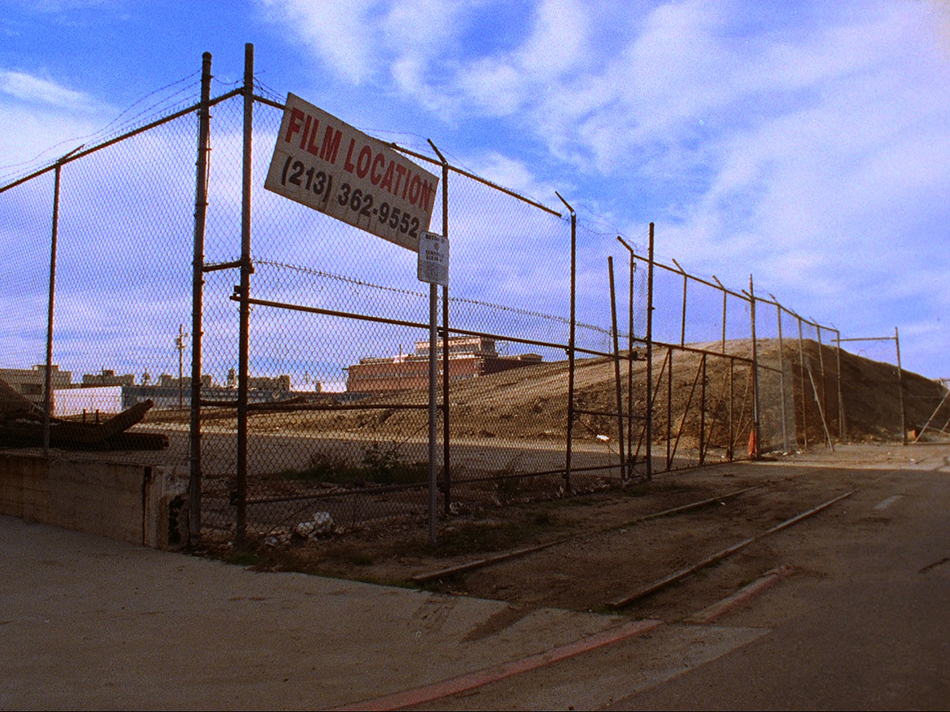
A publicity still from Los Angeles Plays Itself
More than half a lifetime ago I dressed up each morning in a uniform that made me look like Jerry Lewis imitating an airline pilot and drove one of those Gray Line tour buses that have been prowling Beverly Hills and Hollywood since the early 1920s. (“Now wave, guys – there’s Lucy’s house!”) In training, however, I developed a phobia about the “Hollywood at Night” tour: how was I supposed to cope with the stunned dismay, perhaps even terror, of the librarian from Sioux Falls or the young couple from Grover’s Corners when they saw the real Hollywood?
The Boulevard in those days was undoubtedly a great visual inspiration to the future work of Wes Craven and John Carpenter. It was Hippie Skidrow; the outdoor casualty ward for the 1960s. Little Orphan Annie on heroin cowered in a doorway still clutching her doll; a beautiful transvestite who hung around Fredericks of Hollywood, claimed she/he was waiting for a ride from Michaelangelo; a longhaired survivor of some inter-galactic war angrily mumbled to the walls except on holidays – a complete declension of pain, addiction and madness from Gower to La Brea. The LAPD Hollywood Division with routine menace would occasionally frisk a dealer, warn off some Black kids, or perhaps arrest an unlawful defecator.
Tourists from hell might enjoy Hollywood at night but my poor passengers, I fretted, would be no more than prey items. But I shouldn’t have worried. Sioux Falls and Grovers Corners absolutely loved the tour. They oohed and awed at the landmarks, sometimes calling out the names of movies and starts, and then like good pilgrims to Mecca, they got down on their knees to take a snapshot of Mary Pickford’s dainty footprints in the cement in front of Grauman’s Chinese. Although I quickly got into the habit of locking myself inside the bus while passengers worshipped, none of them seemed to sense any menace, and indeed misery seemed to retract into the shadows on their approach.
This went on for months, until I finally took a tourist aside and asked her if she wasn’t shocked, even a little, by the human condition all around her. “My goodness, no, I just ignore all that. But I wanted for years to finally see Hollywood like it looks in the movies.” Revelation. Tourists (why hadn’t I realized this) didn’t come to Hollywood as documentarists or urban explorers; they came to savor the confirmation of images already stored in their minds. Discrepancies were just brushed aside. Hollywood had made the Hollywood in their mind more powerful than any new experience.
No wonder French philosophers love Los Angeles so much. It has been so infinitely filmed, photographed, and stereotyped that the relationship between image and reality seems as complicated as one of those eleven-dimensional pretzels that string theorists believe in it. It’s also ground zero for the future (at least until you visit Vegas or Dubai) as well as the motel that keeps the lights on for wandering hyperboles. Philip Marlowe, postmodernist for hire.
……………
Los Angeles Plays Itself is a detoxification program for those of us who carry around too much Hollywood in our heads, who’ve dabbled too greedily in spectacle and crystal tourism. Thom Anderson – a native with attitude - interrogates celluloid Los Angeles with the cold eye of Joe Friday. ‘Only the facts, mam.’ He’s an unabashed patriot who explains “some lies are malignant. They cheapen or trivialized the real city.”
His film presents movie-made Los Angeles as a dialectical triad. The thesis is that Los Angeles was raped of its identity by the film industry’s insatiable need for ‘background’ and stable clichés. The antithesis is Hollywood’s discovery that it was highly profitable to return to the hole it had dug and fill it with conspiracy theories about Los Angeles history. The synthesis is an alternative neo-realist cinema that cuts straight to the bone of blue-collar life in Los Angeles but that tragically few of us have ever seen: The Exiles, Killer of Sheep, Bush Mama and Bless Their Little Hearts.
The narration begins with an exemplary challenge: “movies”, Anderson says, “do the work of our voluntary attention, and so we must suppress that faculty as we watch. But what if we watch with our voluntary attention, instead of letting the movies direct us?” (I immediately thought of John Nada in Carpenter’s incomparable They Live, finding the magic sun glasses that enable Los Angeles’s defeated proletariat to see the alien Reaganites behind their yuppie guises.)
One of his most fascinating but idiosyncratic topics is the usurpation of native utopia by the film industry. He show how art directors consistently translated Los Angeles’s most visionary architecture – the socialist-spiritualist Bradbury Building, Wright’s famed Ennis and Lovell houses, the famous Case-Study homes in the hills – into sinister décor for Asian crime lords, evil music promoters, pornographers, psycho killers and androids. “These pure machines for living were dens of vice. …The architectural trophy house [became] the modern equivalent of the black hat or the mustache.”
The mordant deconstruction of Blade Runner as “nostalgia for dystopia” is one of my favorite moments in this extraordinary film. Ridley Scott’s future Los Angeles, Anderson points out, is in fact “a city planner’s dream come true. Finally a vibrant street life. A downtown crowded with night-time strollers. Neon beyond our wildest dreamers. Only a Unabomer could find this totally repellant.” (Not to mention the fact that Decker always “finds a parking place next to the front door.”)
Real nostalgia remembers the lost Los Angeles represented by Gilmore and Wrigley fields, the Pan Pacific Auditorium, the Richfield Building, and Ship’s Westwood – all glimpsed in the interstices of old movies. But the soul of Los Angeles Plays Itself is its discussion of “another cinema,” the one created by Haile Gerima, Charles Burnett, and Billy Woodberry. “Who knows the city? Only those who walk, only those who ride the bus. Forget the mystical blatherings of Joan Didion and company about the automobile and the freeways.”
My favorite passage in fiction is the moment in Grapes of Wrath where migrant Oklahoma farmers gather at a California roadside, doodle in the dust with sticks, and begin to figure the necessary transformation of the Family into the People. In cinema, it’s the scene in Charles Burnett’s Killer of Sheep when Stan’s wife is going home on the bus from Beverly Hills to Southcentral. Burnett focuses on her hands lightly placed on the back of the seat in front of her. But as she thinks about the angry, defeated, unemployed man she’ll face at home, her hands tighten around the steel bar until they almost bleed.
This was the Odessa Steps of LA neo-realist cinema, but also, as Anderson observes, the road not taken. It took Burnett’s masterpiece thirty years to find limited commercial distribution; in the meantime, Los Angeles went from the Space Age to Dickensian inequality. The median household income compared to other metropolitan statistical areas fell from third to forty-third. Singing in the Rain became Boyz in the Hood. And despite a so-called Hollywood ‘renaissance’ (the traditional synonym for an explosion in speculative land values), homeless kids still lurk in the alleys and tourists still see what they’ve been programmed to see. Los Angeles as Subject remains as urgent as ever.
Mike Davis
is the author of City of Quartz: Excavating the Future of Los Angeles.
-----
Return to LOS ANGELES PLAYS ITSELF.


